The Challenge: A Workforce Crisis Meets the Data Center Boom
The U.S. electrical trade is facing an acute skills shortage just as the infrastructure it supports is entering a generational buildout. Data center construction, electrification of transportation and buildings, and grid modernization are driving unprecedented demand for skilled electrical contractors — at the same time that an aging workforce is retiring faster than it can be replaced.
For Siemens Smart Infrastructure Electrical Products — which produces the load centers, circuit breakers, panelboards, switchgear, and metering solutions that power everything from residential buildings to hyperscale data centers — the challenge was twofold: prepare a new generation of electricians to install and service increasingly complex equipment, and give Siemens' own internal teams, distributors, and contractor partners scalable access to consistent, current product training.
Legacy training didn't scale. Siemens' earlier XR training modules had to be manually sideloaded to individual VR headsets, with no centralized platform for distribution, scalability, or user-friendly access. The experience was fragmented and resource-intensive — and it couldn't keep pace with the workforce development timelines that data center clients and municipal partners needed.
The Solution: Pneuma, with EducationXR Inside
Siemens developed Pneuma, a next-generation training and sales enablement platform that serves as a one-stop hub for technical guidance, immersive learning, and AI-powered assistance — designed for both internal Siemens teams and external partners including distributors, contractors, and apprentices.
Pneuma combines several capabilities into a single experience:
- Immersive XR training modules — realistic simulations for hands-on electrical training without live voltage or hardware.
- 3D and XR-compatible product visualization — interactive models of electrical components that can be explored and disassembled before installation.
- AI-powered content discovery — a generative AI assistant that answers product questions, recommends documentation, and guides learning.
- Centralized resource access — spec sheets, video tutorials, and 3D installation guides delivered across mobile, desktop, and VR.
Where EducationXR Fits In
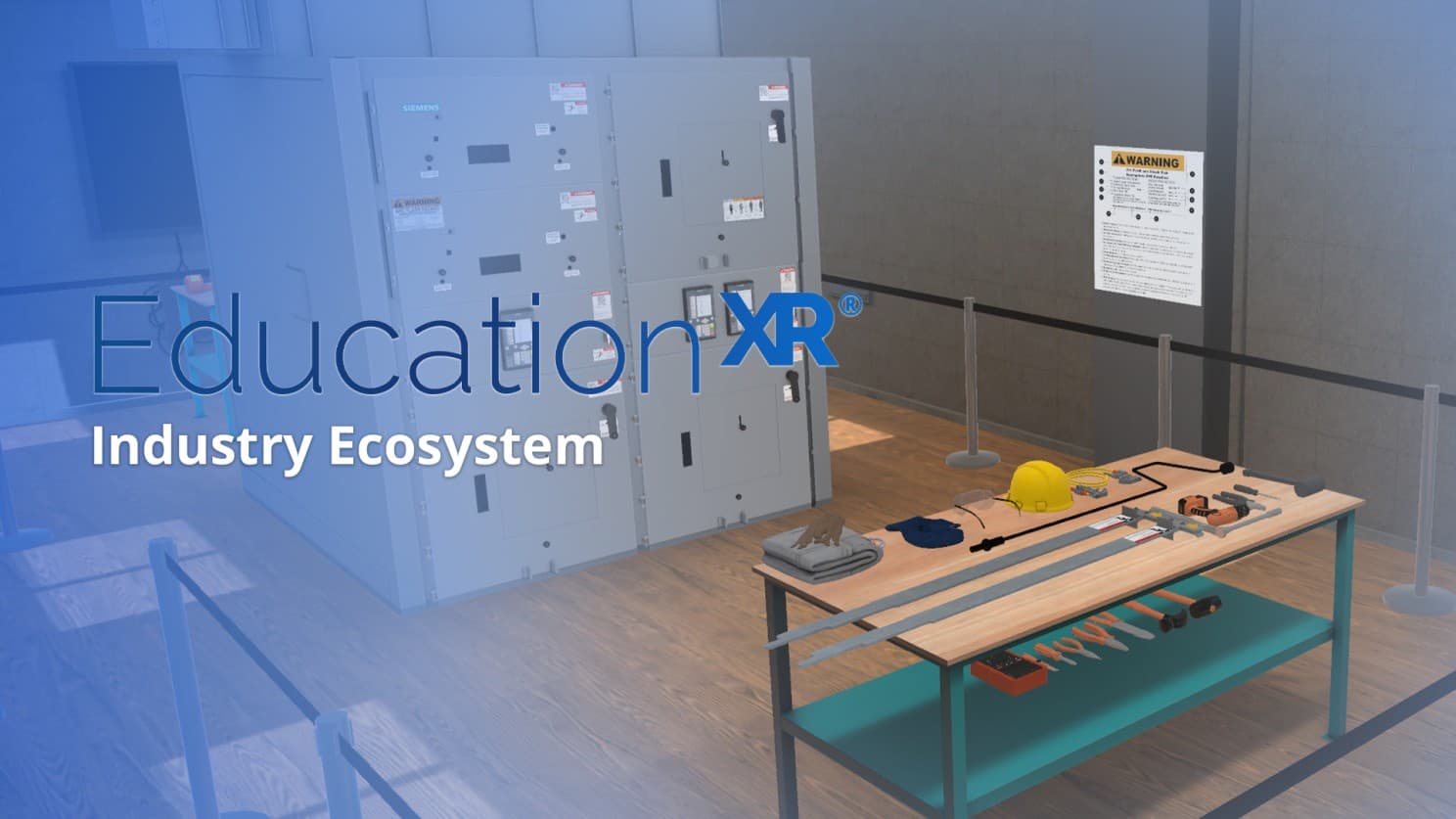
Pneuma and EducationXR are independent products that interoperate. Pneuma is Siemens' platform — its shell, its AI assistant, its product knowledge hub, and its distribution channel to Siemens' internal teams and external partners. EducationXR supplies the XR training modules that Pneuma delivers to learners: the hands-on electrical simulations, procedural practice environments, and interactive equipment walkthroughs that drive the measurable learning outcomes published in this case study.
Those XR training modules are authored using EducationXR's Caffeine package inside Unity Editor. Siemens trainers and subject-matter experts — without game-development backgrounds — use FLOW, EducationXR's visual scripting language, alongside drag-and-drop tooling to build a training module in as little as 15 minutes. Modules are then distributed through EducationXR's cross-platform cloud infrastructure, with a single build reaching Meta Quest, Pico, Windows, macOS, Android, and iOS. Mobile AR, via Unity AR Foundation, turns phones into spatial training devices — letting trainees interact with virtual electrical environments without needing a VR headset.
The division of labor matters: Siemens owns the platform and the learner relationship; EducationXR owns the immersive content pipeline and the multi-device reach. Each company does what it does best, and the combined offering is what Siemens takes to contractors, trade schools, and workforce boards.
Why It Matters: The Data Center Workforce Opportunity
“We are designing and scaling Unity-powered XR training experiences that accelerate workforce readiness for electrical construction — specifically power distribution systems supporting data centers and critical infrastructure. We are creating high-fidelity, competency-based simulations that improve safety, reduce installation errors and rework, shorten time-to-competence, and support faster commissioning. This program will be deployed across contractors, trade schools, and workforce boards, generating measurable ROI while strengthening local talent pipelines that help municipalities attract and sustain data center investment.”
The implication matters beyond training. As municipalities compete for data center investment, the availability of a trained local electrical workforce is an increasingly decisive factor. A data center project that can't find skilled electricians can't commission on schedule — and schedule is what hyperscalers buy. Programs like Pneuma turn workforce development into a competitive economic-development instrument for the regions that host them.
Results
In the first six months after launch, Pneuma delivered measurable outcomes across Siemens' workforce and its broader electrical industry ecosystem:
- 3x improvement in knowledge retention from XR training modules, compared to traditional training approaches.
- 70% reduction in time-to-proficiency on key electrical installation and troubleshooting tasks — translating into fewer costly errors and less job-site rework.
- 10,000+ product and installation questions answered through Pneuma's AI-powered assistant — roughly 125 AI-driven content queries per day.
- 1,000+ active users across Siemens' internal teams, contractors, and distributor partners.
- 25,000 apprentices and educators reached through the broader Siemens Educates America initiative.
- 85%+ weekly interaction rate among external users — a signal that the platform has become essential, not merely useful.
“EducationXR is a creation suite with cross-platform automatic multiplayer (phones, tablets, desktops, VR, etc.). We chose Unity for its cutting-edge XR support and flexibility.”
A Broader Workforce Ecosystem
Pneuma is embedded in a wider set of partnerships that extend the platform's reach beyond Siemens' own teams. Through the Siemens Educates America program, Pneuma reaches apprentices and instructors across the country — and through collaborations with industry bodies including NECA (National Electrical Contractors Association), IBEW (International Brotherhood of Electrical Workers), and IEC (Independent Electrical Contractors), the platform supports the pipeline of skilled talent entering the U.S. electrical trade.
Looking Ahead
Siemens is expanding Pneuma with additional AI-driven content creation tools, new XR training modules in the content library, and a broader rollout across trade disciplines. The underlying question the program is helping answer is a big one: how do you train a workforce fast enough to keep up with the infrastructure the economy is demanding?
EducationXR's cross-platform authoring model — write once, deploy everywhere; authored by SMEs, not Unity developers — is built to scale as that demand grows.